Back to projects 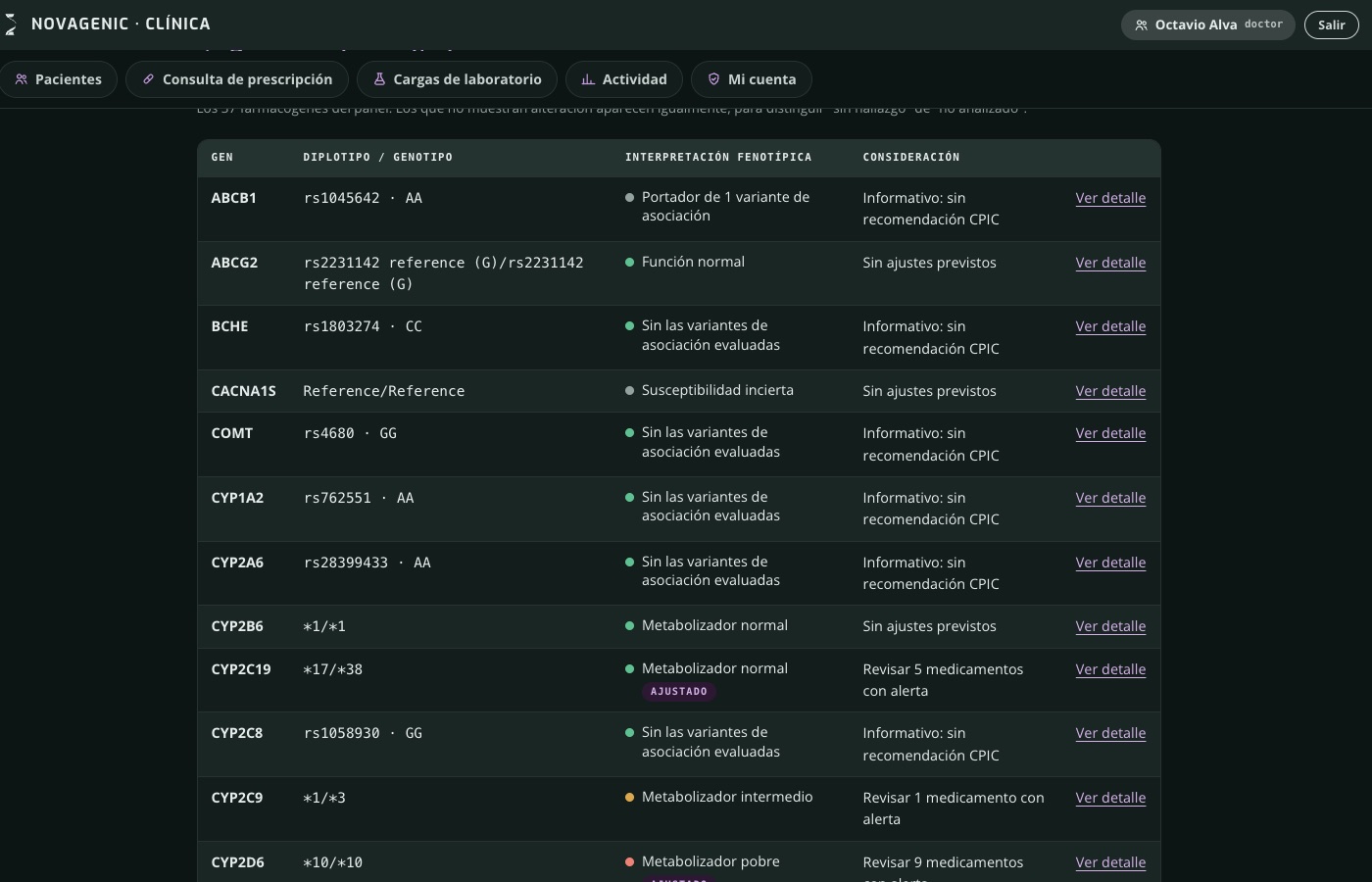
Fullstack
Novagenic — Clinical pharmacogenomics
About the project
Novagenic Clínica — From the lab's spreadsheet to the patient's report
The lab delivers the chip run as a spreadsheet: dozens of samples across hundreds of SNPs, with no names and no interpretation. Novagenic Clínica turns that into a report a physician can read: it calls each gene's diplotypes, looks up the phenotype and recommendations from the CPIC guidelines, and adjusts the result for the medication the patient is already taking. The redesign began with a full technical audit of the previous platform and a working 20-screen prototype.
How it works
Physician
- Uploads the run's spreadsheet; the parser detects sample columns, reads genotypes by rsID, and validates the structure
- Assigns each sample to a patient on a mandatory mapping screen: no confirmed link, no report
- Records and confirms current medication, with brand-name recognition for the Mexican market
- Generates the report, reviews it on screen, and downloads a PDF with its disclaimers and the version of the tables used
- Prescription lookup: asks about a drug the patient is not yet taking and sees the result before prescribing it
Patient and administrator
- The patient signs in with their own account and sees only their report and PDF
- The administrator manages physicians, patients, and admins, with search, pagination, and export
- Bulk reassignment of a physician's patients and deletion of lab runs
- Role isolation verified: a patient cannot read others' reports and a physician cannot see another's patients
The scientific engine
- CPIC/ClinPGx knowledge base precompiled into versioned JSON: 68 SNPs, 37 pharmacogenes, and their recommendations
- Allele calling with CPIC definitions scoped to the panel, including a complementary-strand attempt with its own flag
- Phenoconversion: co-medication cross-referenced against the FDA inhibitor and inducer table adjusts the phenotype
- Catalog of 239 drugs and 587 recognized names, Mexican brand names included
- Limitations printed in the report itself: targeted panel without CNV, strand ambiguity, and key-SNP calling